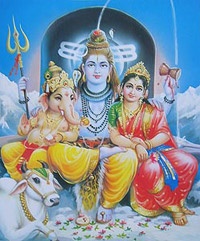
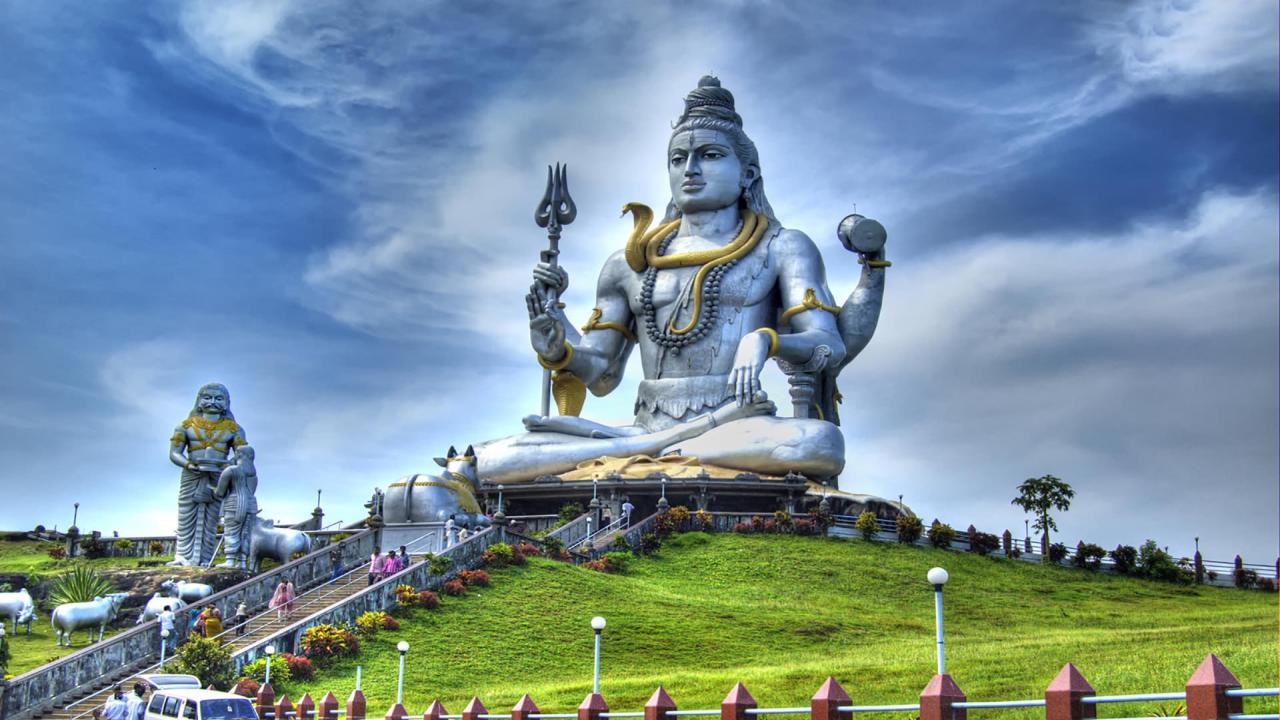
This takes place on the I3th (or I4th) day of the dark half of Phalgun (February-March). The name means “the night of Shiva”. The ceremonies take place chiefly at night.
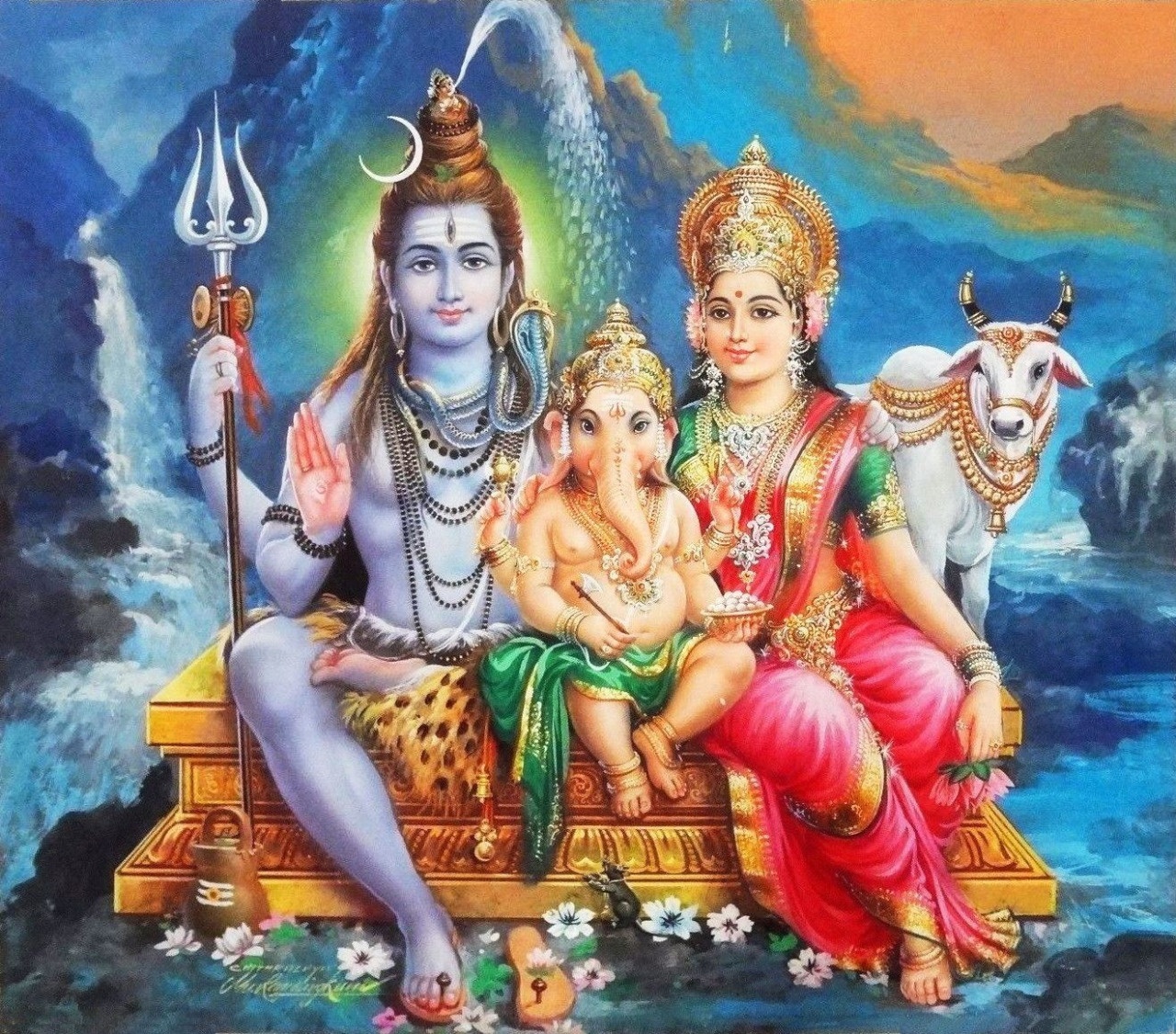
This is a festival observed in honour of Lord Shiva. Shiva was married to Parvati on this day. People observe a strict fast on this day. Some devotees do not even take a drop of water. They keep vigil all night.
The Shiva Lingam is worshipped throughout the night by washing it every three hours with milk, curd, honey, rose water, etc., whilst the chanting of the Mantra Om Namah Shivaya continues.
Offerings of bael leaves are made to the Lingam. Bael leaves are very sacred as, it is said, Lakshmi resides in them. Hymns in praise of Lord Shiva, such as the Shiva Mahimna Stotra of Pushpadanta or Ravana’s Shiva Tandava Stotra are sung with great fervour and devotion. People repeat the Panchakshara Mantra, Om Namah Shivaya.
He who utters the Names of Shiva during Shivaratri, with perfect devotion and concentration, is freed from all sins. He reaches the abode of Shiva and lives there happily. He is liberated from the wheel of births and deaths. Many pilgrims dock to the places where there are Shiva temples.
||Shiv Arti ||
OM JAI SHIV OMKARA, PRABHU JAI SHIV OMKARA
BRAHMA VISHNU SADA SHIV, ARDHANGII DHARA
OM JAI SHIV OMKARA…
EKANANA CHATURANAN PANCHANAN RAJE
HANSANAN, GARURAASAN VRISHVAHAN SAJE
OM JAI SHIV OMKARA….
DO BHUJA, CHAAR CHATURBHUJA DASHABHUJA ATI SOHE
TIINON ROOP NIRAKHATE TRIBHUVAN JAN MOHE
OM JAI SHIV OMKARA…
On the first three days of Navratri, the goddess is invoked as a powerful spiritual force called Durga in order to destroy all our impurities, vices and defects.
The nine nights of celebration which precede the festival of Dussehra or Vijayadashmi, is known as Navratri. There was a time when the world was in the demonic grip of Maheshasura (a demon who had taken the form of a buffalo). The boon of invincibility, made him all powerful, for no man could ever defeat him in battle.
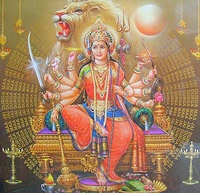
Maheshasura conquered the heavens, and possessed the palace of the gods. The gods pleaded with Shiva for help. Shiva appealed to Parvati, who used her shakti and a goddess appeared from the dark. Durga is the tamasic (dark) incarnation of Parvati. The gods bowed before Durga and offered her their powerful weapons. While the gods watched, Durga battled Maheshasur.
On Vijayadashmi, Durga won back the heavens and earth from Maheshasura when she thrust her trident into his chest and killed him. Navratri is a festival of worship,dance and music celebrated over a period of nine nights.It is celebrated from the first to ninth date of Ashwin Shukla Paksha of the Hindu Calendar for the worship of the Goddess Durga.
Goddess Durga is believed to exist in many forms like Goddess Bhavani, Jagdamba,Mahakali and many many other names.
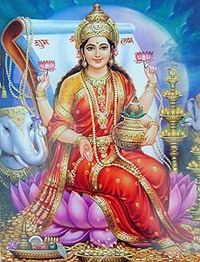
During the next three days, the Mother is adored as a giver of spiritual wealth, Lakshmi, who is considered to have the power of bestowing on her devotees the inexhaustible wealth.
Devotees perform the ‘devi-sthaapna’ in their homes wherein they invite the Goddess and perform ‘pooja-path’ for nine days.
Gujaratis perform their traditional dances ‘Garba’ &’Dandiya-Raas’ during Navratri. The women-folk dance in a circle, singing ‘Garbas’ or traditional songs.’Dandiya-Raas’ is played with wooden sticks or ‘dandiyas’. Apart from Gujrat,Garbas are performed in other states & cities like Mumbai. Beautifully decorated ‘mandaps’are set up for playing garba & dandiya by various cultural societies,housing commitees & youth social groups. Young men-women wear colourful traditional dresses and play Garba with great enthusiasm.
The mood of Navratri is very colourful & unique. In West Bengal, Navratri is celebrated as ‘Durga-pooja’which is the most important festival in that part of India.Celebrations of Durga-pooja in Bengal are similar to celebration of Ganesh Chaturthi in Maharashtra. Idols of Goddess Durga are worshipped for nine days in beautifully decorated ‘pandaals’. It is a public festival. On the tenth day,the ‘Visarjan’ or immersion of idols in sea waters is performed. In various parts of India,the ‘Ram-Leela’ is performed during Navratri.
Ram-Leela is a stage enaction of Ramayana, the story of Lord Rama. The day after Navratri,i.e.,tenth day, is observed as ‘Dassera’ or ‘Vijayadashmi’. It marks the victory of good over evil. It is believed that on this day, Lord Rama had killed the demon Ravana. So, on Vijayadashmi, effigies of Ravana are burnt all over India. During the first nine days of Asvina (aaso) month of Hindu calendar we honor “Divine Mother”.
Three days for Durga (Goddess of valor) three days for Lakshmi (Goddess of Wealth) and three days for Sarswati (Goddess of Knowledge) are devoted to the Trinity of God worshipped in a female form. It is Sakti, identical to the Brahma (absolute) of Vedanta.
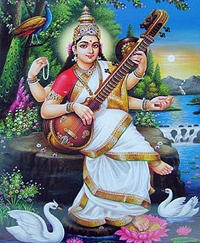
The final set of three days is spent in worshipping the wife of brahma as the goddess of wisdom, Saraswati. In order to have all-round success in life, we need the blessings of all three aspects of the divine femininity, hence, the worship for nine nights.
On the fifth day (Lalita Panchami), it is traditional, to gather all books, light a lamp and invoke Sarswati (Goddess of knowledge and art).
Artisans will rest their “tools” and offer them worship. The eighth and ninth day, it is traditional to perform “Yagna” or Havana (sacrifice offered to the fire- purification and symbolic burning ceremony) to honor “Divine Mother” and bid her farewell.
Some devotees also observe “fast” for 1 day or all the nine days testing their ability to control their senses and create more energy “Sakti”. The tenth day, also known as Vijaya Dasami (day of Victory over evils), Dasara or Dussehra is significant to launch new activities or beginning of learning. In Northern India, huge effigies of Ravana are burnt to celebrate Rama’s conquest of the demon on the Tenth day.
There are parades or Ram lila in many localities. In eastern India, the festival is known as Durga Puja where the images are created, worshipped for 10 days and immersed in the sea. In southern India, houses are decorated with displays of dolls, toys and images of the Gods. In western India, the traditional Garb dance is performed nightly primarily by the ladies. Currently, however Dandiya (with disco beats) has taken a fancy with many men or women as they go in a trance like state with non-stop music.
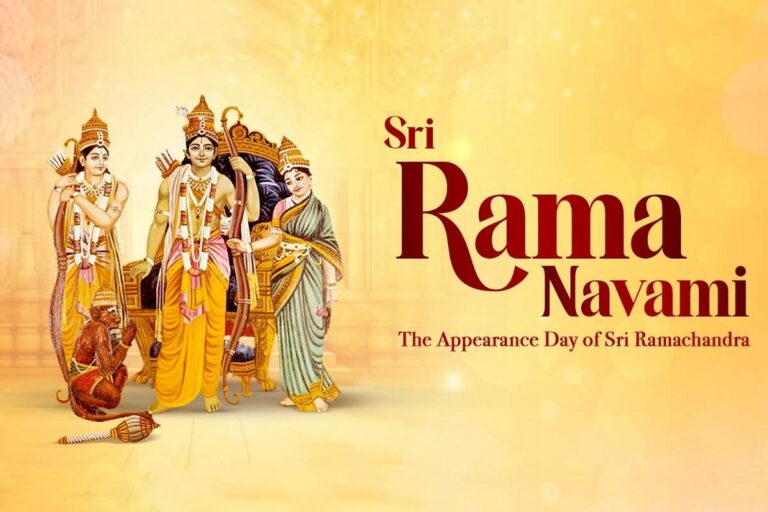
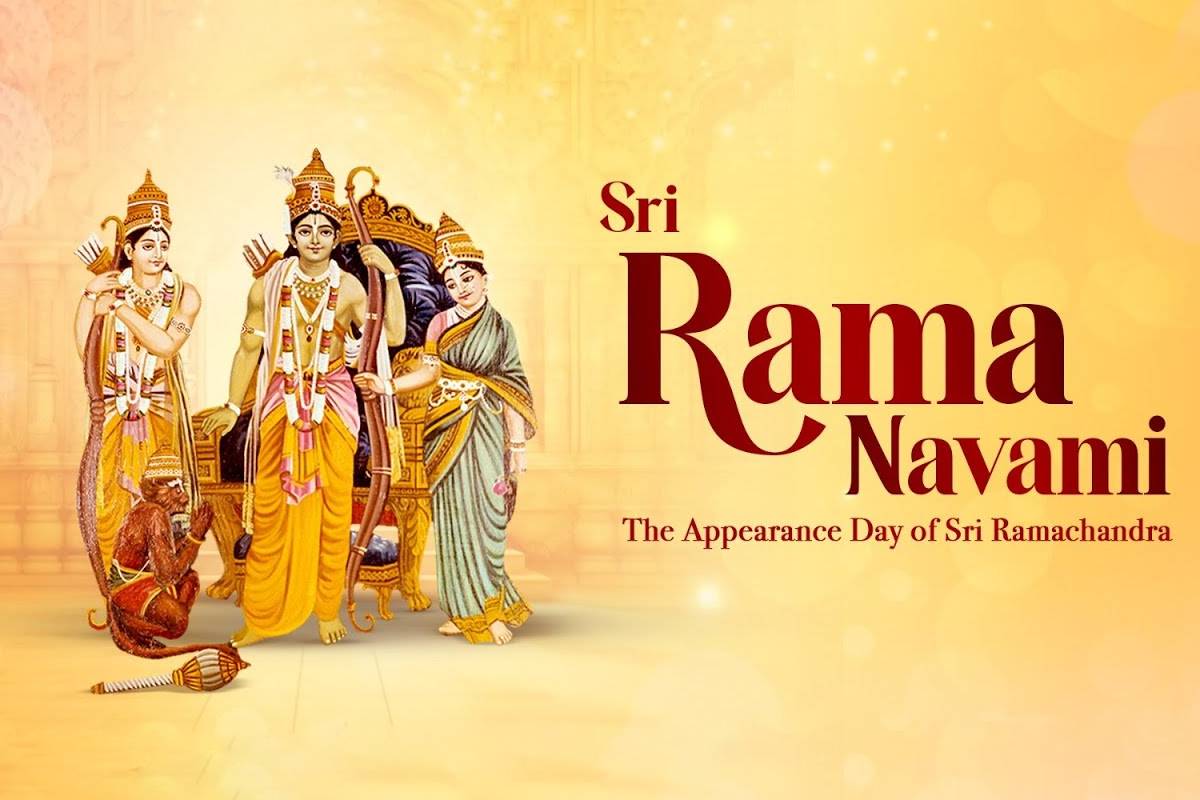
Shree Ram Navami celebrates the birth of Lord Ram or Ramachandra. On the ninth day of the first fortnight of Chaitra the birth of Ram is commemorated. The story of Ram was first written by Vaalmeeki in about the 4th century B.C. Ram is supposed to have lived during the 8th or 7th century B.C. The epic known as the Ramayana. In some parts of India, it is a nine-day festival, coinciding with the Vasanta Navratri.
The public worship starts with morning ablutions, chanting Vedic mantras dedicated to Vishnu, and offering flowers and fruit to the god. People keep a fast throughout the day, breaking it only at midnight with fruit. In some parts of India, especially Bihar and Uttar Pradesh, public gatherings called satsangs are organised to commemorate the birth of Rama. Excerpts from the Ramacharitamanas, extolling the glory of Rama, are recited. People of all castes and creeds participate in these gatherings to listen to the stories and their explanations offered by the learned.
The country of Kosal was situated on the banks of the river Sharayu. Ayodhya was the capital founded by the king rishi Manu. During the reign of king Dasarath, Ayodhya reached a period of great prosperity. But Dasarath faced a big problem: he had no children. Therefore he decided to perform a sacrifice known as “ashvamedh”, or horse-sacrifice. Elaborate and difficult rituals had to be observed. A very holy man, rishi Rishyashring, was chosen to conduct the sacrifice with the utmost accuracy. The performance of this sacrifice was a great event in Ayodhya. At the end Rishyashring recited a mantra and made an offering to the fire. Then the gods, gandharvas, siddhas, and rishis present arid began to pray to Brahma.
At that time Ravan, king of Lanka, was terrorising the people, and all were longing for liberation from his menace. Ravan had acquired great power because he had obtained from god Brahma the boon that he would never die at the hands of gods, or gandharvas, or yakshas (demigods) or demons. As he was not afraid of men he did not care to include men in the list of his potential slayers. So Brahmadev declared that Ravan would die at the hands of a man. Then the gods went to Vishnu with the request, “Dasarath is a glorious king. Please, take birth in the wombs of his three queens in four different degrees of your divinity.”
When Dasarath’s sacrifice came to an end a shining figure appeared over the sacrificial kund, and offered the king a divine beverage called “payasam” to be given to his queens Kausalya, Kaikayi, and Sumitra. In due time Kausalya gave birth to Rama, Kaikayi to Bharat and Sumitra to Laxman and Shatrugna. Rama was born at noon of the bright ninth day of Chaitra. He was believed to be the embodiment of half degree of Vishnu’s divinity, (ardha ounsh).
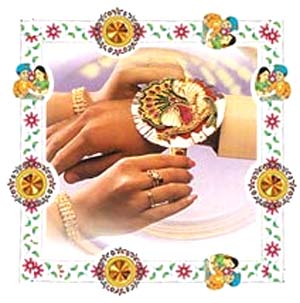
Shrava purnima’s second festival is Raksha Bandhan. This is an ancient tradition. Bhavishya Purana refers to a battle between gods and demons, and Indra (the king of the gods) was feeling depressed. At that time Indra’s wife Sachi took a thread, charged it with sacred verses or Mantras for protection and tied it on Indra’s hand. Through the strength of this thread Indra conquered his enemies. Since then till today this festival is celebrated.
Through the passage of time festivals are undergoing modifications. Raksha Bandhan is also known as Rakhi. Rakhi has become a sacred festival for sisters and brothers. Sisters tie them to brothers. Priests tie them to people of his congregation. During the middle ages, if a woman tied a Rakhi on the hand of any man, then it became imperative for him, as his religious duty of the highest order, to protect that woman. That man would put his life at stake to protect the honour of that woman.
In those days, many Rajputs sacrificed their lives to protect their spiritual sisters. Humayun received a Rakhi from the queen Karmavati of Chittor and for that, Humayun carried out his sacred brotherly duty and protected her by opposing his own soldiers.
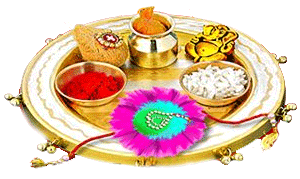
Thali – Rakhdi, Ganesh, Chandlo
According to ancient traditions, it is customary to have protection threads that are charged with sacred verses (Mantras) and sanctified with rice, durva grass etc.; to have these tied by people who know the Vedas or by near and dear ones. This protection thread saves from sins on the one hand and removes diseases on the other hand. By tying this thread, protection is afforded for a full one year and all kinds of fears are removed.
Nowadays Rakhis are decorated with soft silky threads of various colours, and also with ornaments, pictures, gold and silver threads etc. These Rakhis enhance the artistry of the people. Within these Rakhis reside sacred feelings and well wishes. It is also a great sacred verse of unity. Acting as a symbol of life’s advancement and a leading messenger of togetherness.
Each person should celebrate with enthusiasm this sacred festival of Rakhi or Raksha Bandhan. (Raksha = protection Bandhan = tie).
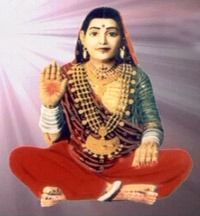
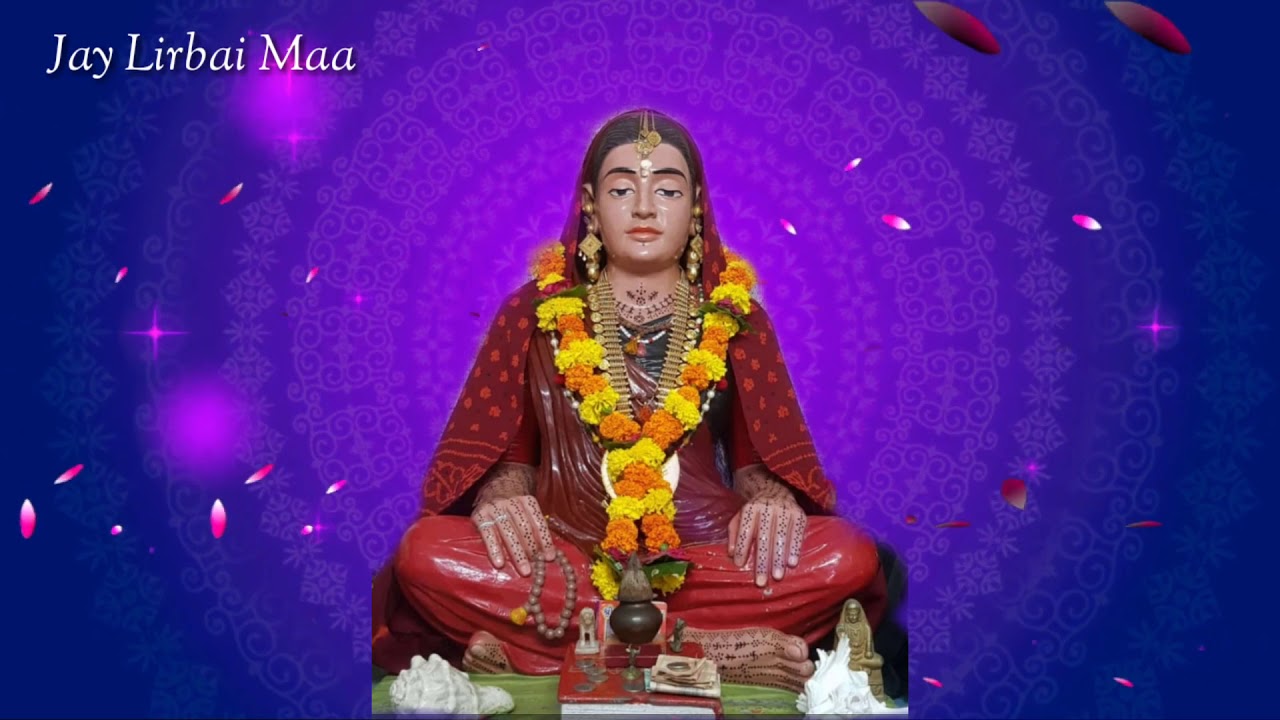
The story of Sati Shree Lirbai Maa has been passed on from generation to generation for over two hundred years.
The story begins with Jeevan Modhwadia. He was from theModhwadaGaam. Jeevan was well-known in Modhwada, however, people knew him for all the wrong reasons. People used to try and avoid him, and try not to catch his eye; if they did they used to shake with fear.
He was near the holy place of Parab; where he stole two bulls from the Patel. He then walked with the bulls, to Parab. Now, even though Jeevan was how he was- notorious, he always, without fail prayed to God in the evening. The Patel happened to go the holy place of Parab and he asked Sant Devidas if he had seen his bulls. Jeevan overheard the Patel saying this and became extremely agitated. Whilst doing his mara, Jeevan prayed to God saying that he had never forgotten to remember the Divine Lord at any day. The Patel asked Sant Devidas again if he had seen his bulls. Sant Devidas replied saying that no-one goes to Parabh if they have been stealing- and if they do by chance-they will never do it again. The Patel asked Sant Devidas if he could go and have a look to see if his bulls were anywhere to be seen. Overhearing this, Jeevan Modhwadia started to worry, knowing that he was going to be caught any second now. The Patel had white bulls, and as Jeevan turned to look at them, they changed to a black colour! The bulls had suddenly changed colour just like Jeevan’s heart was about to…
The Patel approached Jeevan, where he was doing his prayers and noticed that the bulls Jeevan had, were similar to his. He went to Sant Devidas and told the Sant that the bulls looked alike to his, but they were a different colour. The Patel later left and Jeevan started to cry. He couldn’t believe it! He approached Sant Devidas, as he has just finished his prayers and held his feet. In this space of time, Jeevan Modhwadia realised that Bhakti was the path that he wanted to take.
From that day on, Jeevan Modhwadia was known as Jeevan Bhagat. He stayed at the holy place of Parab for twelve years. He did a lot of ‘seva’ and Bhakti.
Then one day, Sant Devidas sat Jeevan Bhagat down and told him that he felt it was time for Jeevan Bhagat to go. He felt that Jeevan Bhagat had a calling to go. Jeevan Bhagat bowed to Sant Devidas and started to walk. He stopped at the Gaam of Vekadi. There, an Ahir family had a function. Jeevan stayed all night and sang Bhajans and Kirtans. The next morning, the Ahir’s daughter, Sonal, decided that she wanted to go with Jeevan Bhagat to Modhwada to do Bhakti. Son Bai’s parents weren’t sure. They didn’t want their daughter to go with an older man, by herself because people would talk. It wasn’t reputable for a girl to go with a single man by herself. Son Bai didn’t say anything and she went to the nearby well to fill some water. She came back and her fingers had divas on them, her tongue was all the way around her neck and the water carrier (Bedu) was three to four inches above her head. This was a parcho and Son Bai’s parents realised that she wasn’t an ordinary woman-but a Maha Sati.
They let her go and Jeevan Bhagat and Son Bai walked and walked until they got to Modhwada. As Jeevan Bhagat had come back to Modhwada after so many years, not many people recognised him. People started to talk. They gossiped saying that they couldn’t understand why Son Bai’s parents had let her go with a man by herself. They tried to look at Son Bai and their eyes started to hurt. There was some much glow and radiance on Son Bai’s face that they just couldn’t even glance at her. People realised that this woman wasn’t an ordinary woman. They also found that the man was Jeevan Bhagat, and everyone was surprised at how much he changed.
In Modhwada Padaar, near the ‘Bava Vaav’ they found a little hut and that is where both of them lived. As people recognised Son Bai’s ‘Shakti Roop’, they often came to their hut where they sang Bhajan and Kirtans and had Prasad.
Regularly, there came a seven year old girl. She used to go to the hut, to get water. There, she used to stay on and sing Bhajans, sweep the floor and help Son Bai and Jeevan Bhagat. She was the daughter of Lakhi and Luno Modhwadia- her name was Liri. Lir Bai enjoyed going to Jeevan Bhagat’s hut where she sang Bhajans until late in the night. Both Son Bai and Jeevan Bhagat were fond of her, and she was like a daughter to both of them. They were fond of her because she was interested in God at such a young age.
A few years later, when Lir Bai Maa grew older, Jetha Bhai Keshwala, from the nearby village of Keshav came and asked Luno Bhagat, if he wanted to give her daughter to their family. Luno Bhagat pondered and decided to ask only two people- Jeevan Bhagat and Son Bai. The next day, Luno Bhagat went and asked them. Son Bai replied saying that all girls should eventually get married, and it was now her time. They told Luno Bhagat that they should take Ramapir’s name and start preparing.
A year later, Lir Bai Maa got married to Vajshi Jetha Keshwala, from Keshav. As Lir Bai passed Son Bai’s hut, she bowed to her Guru’s and put her head on Son Bai’s lap and started crying. Son Bai reminded Lir Bai of her duties, now that she was a wife. She reminded her that she should always keep her parents respect and reputation in mind.
Being quite young and newly married, Vajshi Keshwala had a bad temper and got irritated regularly. He would often go out socialising, come home late and argue with Lir Bai Maa for no reason. Remembering what Son Bai had told her, Lir Bai put up with it as much as she could however, one day, she couldn’t bare it anymore. Getting her belongings, Lir Bai Maa went back to Modhwada, where she stayed at her parent’s house. Frequently visiting her Guru’s, she would sit there for hours singing Bhajan and Kirtans. Two months passed, and Lir Bai Maa still hadn’t come back. Vajshi Keshwala’s friends started to mock him saying that he couldn’t stand up to Jeevan Bhagat or Luno Bhagat. They told him that it was Son Bai and Jeevan Bhagat’s fault that Lir Bai had left. They told him that he should go immediately to Modhwada and confront everyone.
Angrily, Vajshi Keshwala got on his horse and rode up to Modhwada; he found out that Lir Bai Maa was at Jeevan Bhagat’s Hut and that made him angrier. Vajshi Keshwala listened in to the conversation that Son Bai and Lir Bai were having. Son Bai Maa told Liri Maa that a husband is like God and that she should go and return to Keshav as soon as possible. She explains to Lir Bai Maa that she shouldn’t be staying at her parent’s house when she is married.
Vajshi overheard and realised that they weren’t trying to destroy their marriage, but to make it better. He walked in and started crying. Bowing down to Jeevan Bhagat and Son Bai, he apologises and asks for forgiveness. Accepting his apology, Jeevan Bhagat tells Lir Bai and Vajshi Keshwala to go back to Keshav and do a Barporo Paath (Ramapir’s Paath) at Bij (2nd day of the month). Returning to Keshav, he was now known as Vajshi Bhagat.
Now that Vajshi Bhagat had changed, he didn’t like eating meat or going out with his friends. Whenever anyone did anything wrong, he used to confront them and show them that Bhakti was the right way. Slowly, his friends stopped being his friends. Some decided to stay with Vajshi Bhagat and become Bhagats others carried on as they were. When Bij came, there was a Barporo Paath at Vajshi Bhagat’s house. Many people from Modhwada, Keshav and other villages nearby came to enjoy the Bhajans, which lasted for a few days…
Lir Bai Maa went on to have two boys, Punjo and Patho and a daughter called Puti. As a family, they would often sit and sing Bhajans, whenever people came to their house; they would make prasadi and made sure that everyone ate before they left.
On Maha Bij, Vikram Savant 1854, Jeevan Bhagat and Son Bai took their Samadhi in the Gaam of Modhwada. Invitations were sent out to Virpur, Satadhar and Parab. Lir Bai Maa and Vajshi Bhagat found it hard as did many of the people in Modhwada.
One day, Jeevan Bhagat became ill. Even though the people from Keshav advised him to take some medicine, Vajshi Bhagat disagreed. He felt that his time had come for him to take Samadhi. Liri Maa did not agree with this. She explained to Vajshi Bhagat that it was not right for him to go before her, as she is the wife, she should take Samadhi her first. Lir Bai Maa tells Bhagat that many women have died for their husbands and for Vajshi Bhagat to go first-it wouldn’t be right. The only way forward was for someone to give their life to him.
Sati Shree Lirbai Maa’s Mandir in village of Sisli
Contemplating this, the next morning, Puti Bai got some Tulsi leaves; water and incense gave it to Vajshi Bhagat and told him that she would give her life to him. She explained that Punjo and Patho were sons and that they would carry on the family name. Sati Puti Bai was ten years old when she gave her life to her dad. Her mandir and Samadhi is in Keshav. She is known as ‘Puti Sati Aai’.
Punjo and Patho got married to two sisters from the Gaam of Tukda. Now that their sons were grown-up and married, Lir Bai and Vajshi Bhagat gave all the responsibilities to them.
Wanting to take her Samadhi at Modhwada near her Guru’s, Lir Bai went and asked Vangha Patel if that was possible. Knowing that Lir Bai was a Devi, he carefully explained to Lir Bai, that he or the rest of the people in Modhwada couldn’t bear to see their daughter being buried in her home Gaam.
Without uttering a word, Lir Bai Maa returned to Keshav, where she felt that she wanted to leave Keshav and go to the village of Kandora. The people of Keshav were upset and they kept questioning the reason why Lir Bai Maa wanted to leave. Sati explained that she felt like Kandora was calling her and that it was in her destiny to go. Settling in Kandora, Liri Maa held a Barporo Paath, where Nathoo Bhagat from Kotri came; Natha Bhagat from Ratadi, Rajshi Bhagat from Nagka and Rudi Aai from Modhwada. Every Bij, Lir Bai Maa and Vajshi Bhagat held a Barporo Paath. They would sing Bhajans have prasadi.
The time came when Lir Bai Maa wanted to take her Samadhi. Her time had come and she knew that she had to go. Calling Natha Bhagat, Nathoo Bhagat, Rajshi Bhagat and Rudi Aai, as well as many others, Lir Bai Maa held her last Barporo Paath. Sati Shree Lir Bai Maa took her Samadhi on Maha Bij, Vikram Savant 1832.
Vajshi Bhagat took his Samadhi a year later.
There are many mandirs of Lir Bai Maa, which are in Modhwada, Keshav, Kotdi, Rana Kandorana, Sisli and Kinderkheda- to name a few. Not only was Lir Bai Maa a Maherani, but she was a Maha Sati that uplifted the Maher name and made the Maher Naat proud.
Written by Nisha Bhima Karavadra, Peterborough (UK)
Choghadia is used to check the most auspicious time of the day.The Choghadia is a table which is based on the relative position of the heavenly bodies (the planets and the moon) over 24 hours of the day. It is used to check the time (day or night) which is auspicious and therefore best for performing puja, starting a journey, engagements and during special festivals etc.
Typically a Priest would provide similar information. Here’s translated Choghadia into English. Lhabh, Shubh and Amritare auspecious. Kal, Udveg and Rog are inauspicious.
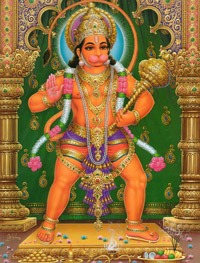
Hanuman Jayanti is celebrated to commemorate the birth of Hanuman, the monkey god widely venerated throughout India. It is celebrated during the month of Chaitra. Hanuman was an ardent devotee of Lord Rama, and is worshipped for his unflinching devotion to the god. From the early morning, devotees flock Hanuman temples to worship the monkey god.
Hanuman Jayanti is an important festival of Hindus. Hanuman is the symbol of strength and energy. Hanuman is said to be able to assume any form at will, wield rocks, move mountains, dart through the air, seize the clouds and rival Garuda in swiftness of flight. He is worshipped in folk tradition as a deity with magical powers and the ability to conquer evil spirits.
The devotees will visit temples and apply tilak of sindhoor to their foreheads from the Hanumans body as this is considered to be good luck. According to the legend Sita was applying sindhoor to her head, Hanuman Ji questioned why and replied that this would ensure a long life for her husband. Hanuman then smeared his entire body with sindhoor, in an effort to ensure Rama’s immortality.
Cultural programs are organised in most of the temples on this day.
Hanuman Story
By the grace of the deities Shiva and Vayu, Anjana (Anjani), wife of Kesari, king of the monkeys, gave birth to Hanumanji. Therefore he is also known as: Anjanisut (sut means son), Anjaneya, Pavansut, Marutsut, Maruti and Vajrang. Pavan and Marut denote Vayu deva. Vajra means indestructible and Indra’s weapon. Ang means body.
Pre-birth Story
Once Angira rishi visited Indra in Swarg. Indra welcomed him by arranging a dance by a damsel named Punjiksthala. As soon as she commenced dancing, the rishi closed his eyes to meditate on Paramatma. When the dance ended, the rishi remained silent. Indra then asked him, “O rishi! How was the dance?”
“We were absorbed in meditation of the Almighty. Such dance does not interest us.” Indra felt ashamed. However, the ego-filled damsel sneered, “How can such a (fickle) rishi appreciate dancing in Swarg?” Hearing this, Angira cursed her, “Behold! You shall degrade to earth from Swarg. You will be born as a female monkey in the mountain forests.”
The whole of Swarg plunged into consternation. The damsel greatly regretted and repented. She repeatedly begged for forgiveness. Finally, the merciful rishi solaced her, “A great devotee of Paramatma will be born to you. He will forever serve Paramatma.”
This damsel was the daughter of Kunjar, the king of the monkeys. She married Kapiraj Kesari of Mount Sumeru.
Therefore, Hanumanji manifested as a result of five divine factors:
1. Angira rishi’s curse and subsequent blessings
2. Anjani’s prayers
3. Shri Mahadevji’s (Shiva’s) blessings
4. Attainment of Shiva’s divine shakti by Vayu deva and
5. The fruit of a Putreshti Yagna
The Shiva Puran cites that since Shiva could not serve Shri Ram in his present form, he inspired the birth of one Rudra from his 11 Rudras, as a monkey, Hanumanji.
Once when Hanumanji was young Surya deva (Sun deity) imbued him with knowledge of countless weapons and mantras. However, his hyperactive nature induced him to think of swallowing the `red, ripened fruit’ – the Sun! Before he succeeded, Indra hit him with his Vajra and persuaded him not to. On being hit by the Vajra, his beard – hanu-, became slanted. Therefore he also became known as Hanuman. The “ji” suffix after any name accords respect. Indra then blessed him that he will eternally remain undefeated, victorious. Hanumanji also obtained boons from Varuna deva (water deity) and Yama – deity of death, victory and immortality. From Brahma he obtained the power of inducing fear in enemies, of destroying fear in friends, to be able to change his form at will and to be able to easily travel wherever he wished. From Mahadevji he obtained the boons of longevity, scriptural wisdom and ability to cross the ocean (Padma Puran, Patal Khand, 114, Uttar Khand, 66, Narad Puran, 1.79).
Now Hanumanji attained a supremely formidable form. However as such, he began harassing rishis. Therefore Bhrugu rishi and Angira admonished him that he would forget the ability to use his formidable power and only a divine personality will later guide him to use it appropriately.
Henceforth Hanumanji lived an ordinary simian life in Kishkindha, on Mount Hrushyamuk as Sugriva’s advisor. Only when Shri Ramachandra and Lakshman arrived in search of Sita, did the two first meet. (Valmiki Ramayana Kishkindha 1-4). Thus his life turned a new course. Ramchandraji asked him who he was. Gleaning his identity, Hanumanji humbly replied, “O Prabhu! From the body’s point of view, I am your das (servant) and From the jiva’s view, I am your bhakta.”
Pleased with his wise reply, Shri Ram accepted his seva. Hanumanji and Sugriva then gathered and sent a mighty army of monkeys to aid Shri Ram in search of Sita. (V.R.Kishkindha 40-41).
When Hanumanji struck southwards towards Lanka, Ramchandraji gave him his ring. In case he met Sitaji, he would need to show it to prove that he was Shri Ram’s envoy. Accompanied by Jambuvan, they all arrived on India’s southern shore. Jambuvan graced Hanumanji. This resulted in him recalling his phenomenal power. Uttering “Jai Shri Ram!” Marutsut leaped high across the ocean towards Lanka!
Here, at night, assuming a subtle form, he entered Lanka. He combed through Ravan’s palace, yet failed to locate Sitaji.
However during his search his phenomenal level of brahmacharya manifested.
Bhagwan Swaminarayan singularly highlights this in Vachanamrut Jetalpur 2. He avers that while searching for Jankiji (Sitaji), Hanumanji looked at every demoness in Ravan’s palace, including Mandodari, Ravan’s wife. After leaving, he wondered whether glancing at so many women would affect him (his brahmacharya) adversely? He then realized that he had done this to look for Jankiji by Ramchandraji’s command. Additionally, his senses and consciousness by Ramchandraji’s grace had not faltered. He then continued his search. In the midst of such allurements, one who remains unallured like Hanumanji, remarked Bhagwan Swaminarayan, is known as a yati.
Throughout the Ramayan one observes that whenever a vexing problem arose warranting diplomacy, Valmiki lauds Hanumanji as a confluence of such virtues as: integrity, valor, intelligence, strength, patience and wisdom. Hanumanji resolved such problems with finesse and devotion. When he finally located Sitaji, to first soothe and gain her trust, since more than likely she’d be frightened and would take him as one of Ravan’s mayic form, he began to recite the glory of King Raghu’s lineage while hidden among the trees. He then further recited Ramchandraji’s glory. Sitaji’s misery, loneliness and distress vanished. Charged with joy, she then requested the deity who sang the glory to present himself!
When Ravan’s son Indrajit used his miraculous weapons, rendering Lakshman unconscious, Hanumanji’s supreme devotion as the ideal devotee manifested. Advised by the Ayurvedic physician Sushena, to fetch the four types of herbs on mount Dronachal to revive Lak
shman, Hanumanji flew there. Not recognizing the herbs, he returned with the whole mountain! This miraculous power arose from his unalloyed devotion to Shri Ram and his brahmacharya.
During Shri Ram’s coronation, Sitaji gifted her invaluable pearl necklace to Hanumanji in jubilation. Being a detached and loyal devotee, he cracked a few pearls with his teeth. Not discovering his master inside, he discarded the necklace!
In a packed assembly, when somebody questioned him whether he really had Sita and Ram in his self, he literally tore open his chest to reveal both, in his heart! Seeing such devotion, Ramchandraji embraced him and granted a boon. “Wherever my katha is being recited, you shall always be there… I shall never ever be estranged from you!”
Shri Ramchandraji further added, “O Hanuman! You have helped me countless times, even if I give my life for you repeatedly, I cannot repay your debt. What then can I give you?” After pausing a few moments he added, “I give you what I possess; I gift you my love and grace!” He then embraced Hanumanji! Such occasions are a true devotee’s supreme moments of fulfillment.
Another virtue of Hanumanji that Valmiki lauds is Buddhimataam Varishtham – the supreme among the wise. One well known episode reflects his wisdom. Once Mahadevji visited Shri Ram’s court in Ayodhya. Ramchandraji welcomed him by offering a grand seat. He then requested Hanumanji to fetch milk. On fetching the milk, Hanumanji experienced a slight dilemma. Being a pativrata devotee (supremely loyal) of Shri Ram, how could he offer the milk to Mahadevji? Instantly he handed the bowl to his Master. Therefore Ramchandraji pointed out, ‘O Hanuman. The guest is Mahadevji. Why do you offer me the milk?’
Instantly Hanumanji replied, “Prabhu! Mahadevji is such a lofty guest that it would not be fitting for a lowly servant as me to offer him anything. It would only be appropriate for you to offer him the milk!”
Bhagwan Swaminarayan lauds his glory as: one who has Pativrata – unalloyed bhakti towards Shri Ram (Gadhada III.16), being ideal in dasatva bhakti (Gadhada II.62) and as supreme yati (Jetalpur 2). Muktanand Swami accords him the titles jitendriya – one who has mastered his indriyas and naishthikendra – one who is a naishthik brahmachari. In the Hindu Dharma, he is rightfully venerated as a deva who is an ideal devotee of Ramchandra Bhagwan. The appellation “monkey god” by non-Hindu writers is a flagrant misnomer, depicting their ignorance. This too applies to Shri Ganeshji, who is also a deva and not an elephant god.
In the Vachanamrut then, Bhagwan Swaminarayan exhorts every devotee to imbibe Hanumanji’s three foremost virtues of the ideal bhakta; pativrata bhakti, Dasatva bhakti and Naishthik brahmacharya.
In the Shikshapatri, Bhagwan Swaminarayan advocates Hanuman pujan on Aso vad 14 (Kali Chaudash) and enjoins those afflicted by evil spirits to chant the Hanuman Stotram (Shik. 127, 85).
In all the mandirs of the Swaminarayan Sampraday Hanumanji and Ganeshji are consecrated in their own special shrines in the front of the mandir. He is offered special pujan on Saturdays with oil and white ankada flowers (Calotropis gigantea – Swallow wart).
Hanuman Aarti
Aarti Keejai Hanuman Lalla Ki, Dushtdalan Raghunath Kala Ki
Jake bal se girivar Kanpai, Rogdosh Bhaye nikat na Janke
Anjani putra maha baldahi, Santan ke prabhu sada sahai
De veera Raghunath pathaye, Lanka jari Siya sudhi laye
Lanka so kot samudra si khai. Jat Pavansut var na lai
Lanka jari asur sab mare, Siyaramji ke kaaj sanvare
Lakshman murchit pare dharni pai, Aani Sanjivan pran uvare
Paithi patal tori yamkare, Ahiravan ke bhuja ukhare
Bhahe bhuja sub asurdal mare, Dahine bhuja santjan tare
Sur nar munijan aarti utare, Jai Jai Jai Hanumanji uchare
Kanchan thar kapur lau chhai, Aarti karat Anjani mai
Jo Hanumanji ke aarti gavai, So vaikunt amarpad pavai
Lanka vidhvans kiye Raghrahi, Tulsidas prabhu kirti gahi
The month of Shravan is the fifth month of the Hindu calender beginning from Chaitra, and is the most auspicious month of the Chaturmas. On Purnima or fullmoon day, or during the course of the month the star ‘Shravan’ rules the sky, hence the month is called Shravan. This month is spread out with innumerably religious festivals and ceremonies and almost all the days of this month are auspicious.
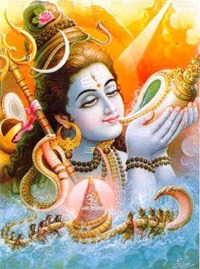
Shravan is considered the holiest month of the year. Each monday of this month, known as Shravana Somvar, is a special day in Shiva temples where the dharanatra hangs over the linga or the idol to bathe it with holy water, day and night. Devotees pile the linga high with Bel leaves and flowers and fast till sunset. The nandadeep (24 hour lamp) burns steadily in the temples.
Lord Shiva and Shravan Mas
The legend says that when the churning of oceans – Samudra Manthan – took place in the month of Shravan, fourteen different types of rubies came out. Thirteen of these were distributed amongst the demons, except Halahal (poison). Lord Shiva drank the Halahal and stored it in his throat. Hence the name Neelkantha (meaning blue throat) is attributed to Shiva.
To reduce the strong effect of poison, Lord Shiva wore the crescent moon on his head. All the Gods, thereafter started offering the Ganges water to Lord Shiva to make lessen the effect of poison.
Since, this happened in the month of Shravana, since then the Shiva devotees offer the Ganges water in this month.
It is considered highly auspicious to wear a rudraksha in Shravan month. As, Mondays or Somvars of Shravan month are specially observed with austerity. All Mondays are devoted to the worship of Shiva as this day is sacred to Lord Shiva. No other Mondays of other months are so greatly honoured.
The belief is that in Shravan month, offering milk to Lord Shiva earns a lot of Punya.
Things to do during Shravan month
• Wear Rudraksh, and also use a Rudraksh mala for Japa.
• Offer Lord Shiva Bhibhuti and place some on your forehead.
• Make offerings of Bel leaves, Panchamrut (milk, yoghurt, clarified butter, honey and jaggery) on Shiva Ling.
• Recite Shiv Chalisa and Aarti
• Chant Maha Mrityunjaya Mantra.
• Fasting on Mondays. Girls who fast on all Mondays of Shravan get a good husband.
Significance of Shravan Weekdays
Each day in the month of Shravan has a special significance and has its own ritual.
Monday: is the day of Lord Shiva worship. Tuesday: Gauri is worshipped in every home, by women for the good health of their family. Wednesday: are dedicated to Vithala, a form of Vishnu or Krishna. Thursday: are also days for worshipping Buddh and Guru. Friday: every home worships Lakshmi and Tulsi. Saturday: are for Saturn (Shani). It is also known as Shravan Saturdays, with the object of object of obtaining wealth. These days are known as Sampat Sanivara (wealth Saturdays). Sundays: are meant worshipping the Sun god. Sun worship was general in the Vedic period and even now it is so. Especially in Shravan, every Sunday the Sun is worshipped without fail.
Festivals in Shravan Month
During this month people practice many rules and regulations while praying and also fast. Shravan has a special importance as it ushers in a host of auspicious days and festivals like:
Naga-Panchami
Kalkyavatara
Putradaikadashi
Hindola or Swinging
Narali Purnima
Shravani Purnima
Pavitraropana Raksha Bandhan
Vara Lakshmi Vrata
Rishi Panchami
Govatsa and Bahula
Sitala Saptami Janmashtami
Ajaikadasi
Pithori
Pola
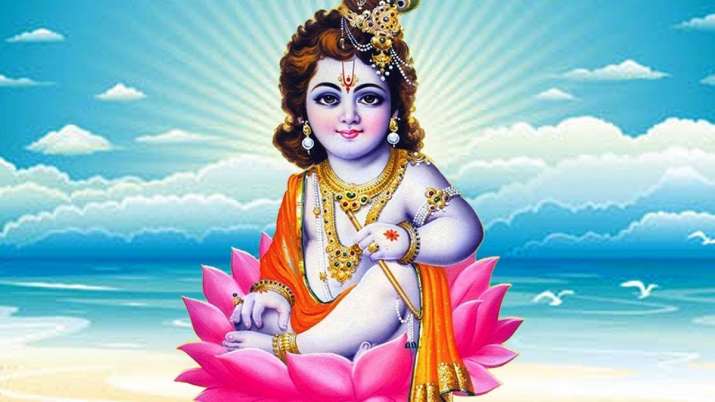
Janmashtami, the birth of Lord Krishna is celebrated with great devotion in the August/September months, on the Ashtami of Krishna Paksh or the 8th day of the dark fortnight in the month of Bhadon, in the whole of north India. Temples and homes are beautifully decorated and lit. An attractive feature of the celebrations are cribs & other decorations depicting stories of Lord Krishna’s childhood. There are five main “jhankis” of Janmashtami which depict the entire sequence of events from Lord Krishna’s birth to his being discovered in Gokul.
The “jhankis” include the birth of Krishna in jail, Vasudev carrying Krishna to safety across the river Yamuna amidst thunder and lightning, Vasudev’s return to the jail, Kansa killing Yashoda’s daughter and finally the little Krishna in the cradle in Gokul. “Jhankis” are created out of dolls dressed up as kids, men and women with lehangas, chunnis, dhotis & kurtas. Raslila of every type are also performed – Janmlila, Shankarlila, Putnalila and Naglila. In the evening bhajans are sung which end at midnight, the auspicious moment when Lord Krishna was born. Thereafter arti is done, prasad distributed and flowers showered on the idol.
Celebrations at Braj Bhoomi
Mathura, the birthplace of Lord Krishna, where his parents lived in captivity of the evil Kansa and he as a young boy came and vanquished his maternal uncle Kansa to ascend the throne and free his parents, celebrates Janmashtami with great enthusiasm. The main celebrations are performed at the Dwarkadhish temple, Mathura in the form of Jhulanotsava and the Ghatas during the entire month of Shravan. The ghatas are a unique feature of the month long celebrations. During the ghatas of a particular colour the whole temple is covered with decoration in the same colour. Even the Lord dresses up in the same colour. The twin cities of Mathura-Vrindavan takes on a festive look and spirit of devotion runs high among the people. It was on the banks of the Yamuna river where Lord Krishna played during his childhood and indulged in pranks and tricks with his friends and the gopies. There are about 400 temples dedicated to Lord Krishna in this sacred city and the major festivities are held at the Banke Bihari, Rangaji, Shri Krishna Balram temple and Gopinath temple. The Raslila of Braj is thematically the basis of many performing arts.
Lord Krishna was born in the DuaparYug which came just before the Kal Yug and Janamasthami, his birthday falls on the Ashtami Paksh or the 8th day of the new moon fortnight in the month of Bhadra some time in July or August. The Jhankis ( tableaux) depicting many significant scenes from Lord Krishna’s life are the intrinsic part of Janmasthami. Devotees also make beautiful Jhulans (Cradles) for the baby Krishna. In some parts of India, young men break the Matkas (Earthen Pots) filled with butter and curds. The most important tableux is that of baby Krishna. A idol of baby Krishna is placed on a cradle, which is rocked to recreate scenes from Krishna’s infancy. The devotees believe that anyone who makes a wish and while rocking the cradle in which the Lord is, his or her wish will be granted on this day. Other popular Jhankis are Kaaliya Mardan(vanquishing the black snake Kali Nag), Kansha vadha ( Killing Kansha) and lifting the Govardhan Parbhat.
In Brindavan, every year the Raasleelas or the folk theatre acting out Krishnas Lifes stories begin much before the Janmasthami day. These Raasleelas are staged by professional drama troupes or even young children. These dramas characterised by colourful costumes and equally colourful backgrounds. Raasleelas are usually accompanied by musicians and are very popular among the people. The language spoken by the actors and the actresses is the Brajbhasha but sometimes Hindi is also used.
Rituals
The ceremony of worship is a very simple affair. The priests chant holy mantras and bathe the idol with Gangajal (water from the holy Ganges river), milk, ghee (clarified butter), oil, and honey pouring all these from a conch shell. Only after the ceremony is over, the devotees break their daylong fast . In Janmashtami, the devotees keep awake and sing bhajans till midnight, the moment when Krishna was born. People fast all day and eat only after the midnight birth ceremony. Often the image of the baby Krishna is placed on a swing and bathed with charanamrit (holy water). Midnight prayers are performed. The sound of hymns and religious songs extol the greatness of Krishna.
This festival occurs on the eight day (Astami) of a lunar fortnight hence the name (Krishna+astami). Krishnastami which comes sometime in August is celebrated over two days. The first day is Krishnastami or Gokulastami. The second day is called Kalastami or more popularly Janmastami.
At midnight between the first and second days the ‘birth of Lord Krishna is replicated with pomp and ceremony. Delicacies are prepared from milk and curds that Krishna loved. The more popular ceremony of Dahi-handi (breaking a pot full of milk and its derivatives} takes place on the second day. This ceremony is so popular that Krishnastami has come to be synonymous with the ceremony of Dahi-handi.
Lord Krishna
The Ceremony of Dahi-Handi
During this ceremony a large earthenware pot is filled with milk, curds, butter, honey fruits etc. and is suspended from a height between 20 to 40 feet. Sporting young men and boys come forward to claim this prize. To do so they construct a human pyramid by standing over each other’s shoulders till the pyramid is tall enough to enable the topmost person to reach the pot and claim the contents after breaking it. Normally, currency notes are tied to the rope by which the pot is suspended. This prize money is distributed among those who participate in the pyramid building.
In his childhood, Lord Krishna along with his mates used to raid the houses of his neighbours in search of milk and butter. It is a common practice in India to tie up food articles in a pot suspended from the beams of the roof so as to prevent domestic animals like cats and dogs from despoiling them. We are told that every day after the men and womenfolk left for their farms, the naughty and adventurous Krishna along with a band of his mates would build a human pyramid and plunder the caskets of milk and butter much to the chagrin of the owners.
Krishna Lila The story of Lord Krishna reflects life in a pastoral society. Cattle are the principal means of subsistence. The activity of people revolves around tending cows, milking them, making curds, butter etc. Krishna himself has names displaying a pastoral charecter. Govinda and Gopala as he is also known, mean cowherd. In Sanskrit ‘go’ means cow.
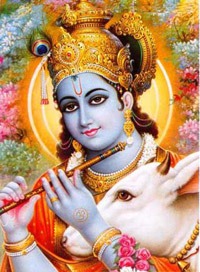
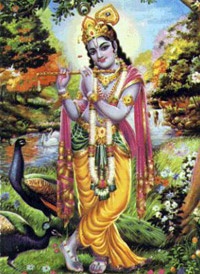
Krishna is always shown with his flute (Bansuri). He is considered to be the Hindu God of Music and is the patron god of Indian musicians of the traditional schools (Gharanas), irrespective of their religion.
In brief the life story of Krishna according to mythology is as follows:
Kansa, the king of Mathura was a very cruel tyrant. His tyranny spared no one, even the sages had to bear the brunt of this. Finally the gods c
ould tolerate no more of it and in a dream Kansa was told that his evil reign would be brought to an end by his sister Devaki’s son who would kill him. The cowardly tyrant immediately threw his sister Devaki and her husband Vasudev in prison so that he could kill all the sons born to Devaki.
The Cruelty of Kansa
In captivity Devaki bore six sons, each of whom were promply killed by Kansa. The seventh time, the gods again thought it necessary to intervene. On the night of the birth of their seventh child, the prison guards fell into a deep slumber and the doors were unlocked. Taking advantage of this opportunity, Vasudev slipped out of the prison and whisked away the God-child to the safety of a neighbouring kingdom which was ruled by king Nanda. King Nanda’s domain lay across the Yamuna river. We are told that at that time the Yamuna was in spate, but when the waters touched the feet of the God-Child Sri-Krishna, the waters parted making a channel for Vasudev to pass.
Lord Krishna at Gokul
The generous king Nanda gave away his new born daughter to Vasudev knowing fully well what fate awaited her at Kansa’s hands. Next morning Kansa completed his gruesome job complacent of the fact that his would-be avenger was still living. At Gokul, under king Nanda’s protection, Krishna got the loving affection of Nanda’s Queen Yashoda whom Krishna looked upon as a mother. Days passed in fun and frolic, while the child-Krishna grew up. But one day rumours reached Kansa that Devaki’s son had somehow escaped his cluthes and was living in Gokul.
The Demoness Putana
To kill Krishna, he engaged a demoness named Putana. After specially treating the demoness Putana so that her nipples were poisoned he disguised her as a nymph and sent her to Gokul to try to breast-feed Krishna and kill him. But God that he was, the child Krishna saw through the game and in a miracle, we are told, the demoness fainted, the moment Krishna’s lips touched her breast. Kansa’s plot to eliminate Krishna was foiled. But as a result of sucking the poisoned milk Krishna’s originally fair skin turned dark. The story of Srikrishna’s life neatly explains away the reason for his dark complexion. But it is quite possible that Krishna was of non-Aryan origin. The word Krishna itself means dark
Kalia Mardan and the Lifting of Mt. Govardhan
Krishna continued to grow at Gokul. He acquired notoriety as a pilferer of milk and butter, but had endeared himself to the people of Gokul by his playfulness.
Among other things, he is said to have done at Gokul, he lifted Mount Govardhan to save the people of Gokul from a storm. He also tamed Kalia, a giant snake that lived in the Yamuna river and terrorised the people of Gokul. While still in his teens, Krishna came to Mathura where King Kansa had organised a wrestling tournament. Krishna participated in it and after defeating all the contestants, he challenged Kansa to a wrestling bout. The evil Kansa’s time was up: Krishna defeated him and killed him. The people of Mathura were relieved.
Another major event in Krishna’s later life was that he functioned as an adviser to the Pandavas and during the Mahabharata war between the Pandavas and Kauravas he was Arjuna’s (one of the five Pandava brothers) charioteer. The original recitation of the Bhagvad Geeta (Song of the Blessed Lord) is accredited to him. This document contains profound ideas on many issues touching on the temporal and non-temporal aspects of life.

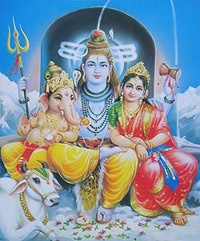 This takes place on the I3th (or I4th) day of the dark half of Phalgun (February-March). The name means “the night of Shiva”. The ceremonies take place chiefly at night.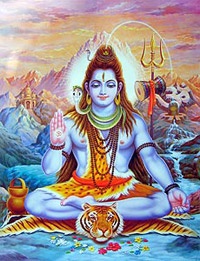


 Sati Shree Lirbai Maa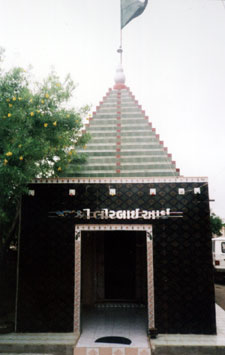
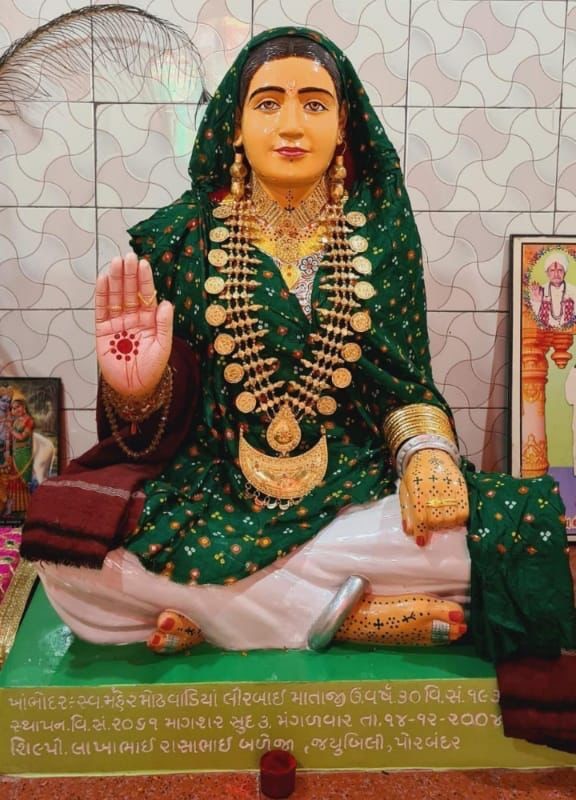 The time came when Lir Bai Maa wanted to take her Samadhi. Her time had come and she knew that she had to go. Calling Natha Bhagat, Nathoo Bhagat, Rajshi Bhagat and Rudi Aai, as well as many others, Lir Bai Maa held her last Barporo Paath. Sati Shree Lir Bai Maa took her Samadhi on Maha Bij, Vikram Savant 1832.

 Festivals in Shravan Month